Coursework
CSCI 127: Introduction to Computer Science
Hunter College, City University of New York
Spring 2026
Homework Labs Code Review Written Quizzes Calendar Final Exam
On Tuesday, January 20, all registered students are sent a Gradescope registration invitation to the email on record with CUNYFirst. If you did not receive the email or would like to use a different account, fill out the form on Brightspace. Include on the form that you not receive a Gradescope invitation, your preferred email, and your EmpID. We will manually generate an invitation. As a default, we use your name as it appears in Brightspace/CUNYFirst (to update CUNYFirst, see changing your personal information). If you prefer a different name for Gradescope, include it, and we will update the Gradescope registration.
Homework
See the Homework page for the list of exercises for the class.
Labs
Each week, you are expected to work through the associated Online Lab. Target dates for completing these are included. There is no deadline for completing these, but the homework, quizzes and coding reviews are based on the information in the lab.
Lab 0: Setting Up.
Target date: Monday, January 26.
Learning Objective: to set up tools for the semester and to read through the syllabus.
Lab 1: First Program & Turtles.
Target date: Wednesday, January 28.
Learning Objective: to write short programs involving output and the turtle library and submit those to the Gradescope.
Lab 2: Strings & Loops.
Target date: Wednesday, February 4.
Learning Objective: to input and manipulate strings, as well as looping through lists and strings.
Lab 3: Representing Colors & Manipulating Images.
Target date: Wednesday, February 11.
Learning Objective: to use the three different formats for colors (name, RGB & hexadecimal) and manipulate images using standard libraries.
Lab 4: Getting Input & Decisions.
Target date: Wednesday, February 25.
Learning Objective: to use decisions to manipulate images and lists (list comprehension) as well as get user input.
Lab 5: Logical Expressions & Circuits.
Target date: Wednesday, March 4.
Learning Objective: to translate between logical expressions and circuits, as well as understand binary numbers.
Lab 6: Pandas & Github.
Target date: Wednesday, March 11.
Learning Objective: to use the pandas library to read in CSV files, manipulate columns, and plot data, as well as be familiar with GitHub.
Lab 7: NYC OpenData & Functions.
Target date: Wednesday, March 18.
Learning Objective: to obtain and analyze NYC OpenData using pandas and to write stand-alone programs with functions.
Lab 8: Top Down Design & Dictionaries.
Target date: Wednesday, March 25.
Learning Objective: to write programs in a top-down design fashion and use dictionaries.
Lab 9: Spatial Maps & Code Quality.
Target date: Friday, April 10.
Learning Objective: to create spatial maps and improve debugging skills.
Lab 10: Indefinite Loops & Random Numbers.
Target date: Thursday, April 16.
Learning Objective: to use indefinite loops in programs and understand canonical Unix tools (git and vi).
Lab 11: Machine Language and Unix Pipes.
Target date: Wednesday, April 29.
Learning Objective: to write simple machine language programs (MIPS) & link shell commands using pipes.
Lab 12: Getting Started with C++.
Target date: Wednesday, May 6.
Learning Objective: to write C++ programs with I/O, variables and definite loops and list file types in Unix.
Lab 13: C++ Decisions & Indefinite Loops.
Target date: Wednesday, May 13.
Learning Objective: to write C++ programs that using decisions and while loops and use shell commands to find versions and documentation.
Written Quizzes
Each week, there will be a paper quiz on the lecture notes, reading, submitted programs, and online lab exercises.
- Quiz questions will cover the topics from lectures, labs, and homework.
- Quizzes are offered on weekdays, 11:30 am to 5:15 pm in lab 1001E HN. First priority is given to those with appointments (available on Navigate) and then walk-ins.
- There are no make-up quizzes. Instead, the top 10 scores are used to compute your quiz grade.
- Extra credit (up to 15%) is available for completing quizzes by the target date. See calendar for dates.
- The quizzes are on paper, and you may not use any notes, books, or any computer device (laptop, phone, calculator, smart watch, etc.).
Code Reviews
There will also be weekly walk-throughs ("code reviews") where you explain one of the programs you wrote for homework to a teaching assistant. Code reviews are integral to software design and development: explaining your coding decisions and convincing another it works correctly leads to improvements in the design and lessens unexpected behaviors and errors.
- Code reviews are offered on weekdays, 11:30 am to 5:15 pm in lab 1001E HN. First priority is given to those with appointments (available on Navigate) and then walk-ins.
- Each week focuses on program that you wrote the previous week (see calendar for programs).
- Using IDLE, you code up the program from scratch. As you're doing this, you guide the teaching assistant through your design and development.
- If something is unclear or you are stuck, ask questions! Having a two-way conversation about the concepts, the code, and the design are highly encouraged.
- After you successfully code and run your program, the teaching assistant will ask you to modify it (a very common part of technical interviews).
- There are no make-up code reviews. Instead, the top 10 scores are used to compute your quiz grade.
- Extra credit (up to 15%) is available for completing code reviews by the target date. See calendar for dates.
Calendar:
Unless otherwise noted, all quizzes and code reviews are in-person in 1001E HN. There is up to 15% extra credit for completing the quiz and code review before the due date: 5% for 1 day early, 10% for 2 days early, and 15% for 3 or more days early.
| Week: | Start Date: | 3 Days Early: (15% Extra Credit) | 2 Days Early: (10% Extra Credit) | 1 Day Early: (5% Extra Credit) | End Date: | Quiz Topics: | Code Review Topics: |
|---|---|---|---|---|---|---|---|
| #0 | Tuesday, January 20 | None | None | None | Tuesday, February 3 | Quiz 0: On Brightspace: covers syllabus. | None |
| #1 | Monday, January 26 | Thursday, January 29 | Friday, January 30 | Monday, February 2 | Tuesday, February 3 | Quiz 1: Turtles and Loops: Focuses on turtle commands and for-loops. Use Lab 1 to study. | Code Review 1: Hello (HW 1) |
| #2 | Wednesday, February 4 | Thursday, February 5 | Friday, February 6 | Monday, February 9 | Tuesday, February 10 | Quiz 2: Looping through strings and using ASCII values; Unix commands: files & directories; see Lab 2. Quizzes include reference sheet with ASCII chart. | Code Review 2: Using Turtle Library (HW 3 & 5) |
| #3 | Wednesday, February 11 | Thursday, February 19 | Friday, February 20 | Monday, February 23 | Tuesday, February 24 | Quiz 3: Color formats, slicing, and Unix commands from Lab 2 and Lab 3. | Code Review 3: String Methods (HW 7 & 9) |
| #4 | Wednesday, February 25 | Thursday, February 26 | Friday, February 27 | Monday, March 2 | Tuesday, March 3 | Quiz 4: Inputting, decisions, & list comprehensions. See Lab 4. | Code Review 4: Definite Loops (HW 8 & 10) |
| #5 | Wednesday, March 4 | Thursday, March 5 | Friday, March 6 | Monday, March 9 | Tuesday, March 10 | Quiz 5: Manipulating strings and lists with split() and join(); Loops & Turtles. See HW 11-15. | Code Review 5: Getting Input (HW 11 & 16) |
| #6 | Wednesday, March 11 | Thursday, March 12 | Friday, March 13 | Monday, March 16 | Tuesday, March 17 | Quiz 6: Converting between binary, decimal, and hexadecimal; Logical Circuits. See Lectures 2 & 5 and Lab 5. | Code Review 6: Images (HW 19 & 21). P19 modifies the map-making program from Lab 4, so, you can start with that program loaded in IDLE for the code review. |
| #7 | Wednesday, March 18 | Wednesday, March 18 | Thursday, March 19 | Monday, March 23 | Tuesday, March 24 | Quiz 7: Manipulating CSV files with Pandas (Lab 6) and Unix paths (Lab 4 and Lab 5). | Code Review 7: Logical Expressions & Circuits (HW 23 & 25). First draw in CircuitVerse, then give logical expression. |
| #8 | Wednesday, March 25 | Thursday, March 26 | Friday, March 27 | Monday, March 30 | Tuesday, March 31 | Quiz 8: Decisions, Python's zip (see Lab 4, Lab 5, and Lab 7). | Code Review 8: Decisions (HW 24 & 26). P24 modifies the turtle string program, so, you can start with that program loaded in IDLE for the code review. |
| #9 | Monday, April 13 | Monday, April 13 | Tuesday, April 14 | Wednesday, April 15 | Thursday, April 16 | Quiz 9: Functions (Lab 7) and Regular Expressions (Wildcards) in Unix (see Lab 8). | Code Review 9: Pandas (HW 27 & 28). P27 modifies the program from Lab 6, so, you can start with that program loaded in IDLE for the code review. |
| #10 | Friday, April 17 | Friday, April 17 | Monday, April 20 | Tuesday, April 21 | Wednesday, April 22 | Quiz 10: Dictionaries (see Lab 8). | Code Review 10: Functions (HW 35 & 38) |
| #11 | Thursday, April 23 | Thursday, April 23 | Friday, April 24 | Monday, April 27 | Tuesday, April 28 | Quiz 11: Spatial Data & Finding Errors (Lab 9). | Code Review 11: Dictionaries (HW 39 & 40) |
| #12 | Wednesday, April 29 | Thursday, April 30 | Fridayday, May 1 | Monday, May 4 | Tuesday, May 5 | Quiz 12: Indefinite Loops and Unix Scripts (see Lab 10) | Code Review 12: Pandas & Plotly (HW 44 & 48) |
| #13 | Wednesday, May 6 | Thursday, May 7 | Friday, May 8 | Monday, May 11 | Tuesday, May 12 | Quiz 13: Machine Language (see Human Resource Machine in Lab 11) & C++ (see Lab 12). | Code Review 13: Indefinite Loops (Program 47) |
| #14 | Wednesday, May 13 | Thursday, May 14 | Friday, May 15 | Tuesday, May 19 | Quiz 14: C++ (see Lab 12 and Lab 13). | Code Review 14: C++ (HW 56 & 58) |
Final Examination
The final exam is required. It is comprehensive, covering all the material of the course.
- You must take and pass the final (60 points or more) to pass the course.
- The final exam will be during the registrar's assigned time slot: Monday, May 26, 9-11am.
- Since we have lecture only once a week and share time slot for lecture, we also share the final exam time slot. To accommodate students with conflicts, there will also be an early final exam time (TBA).
Material Covered:
The final exam will cover the material in:- Homework,
- Quizzes,
- Code Reviews,
- Lab Exercises,
- Reading & Handouts, and
- Lecture notes.
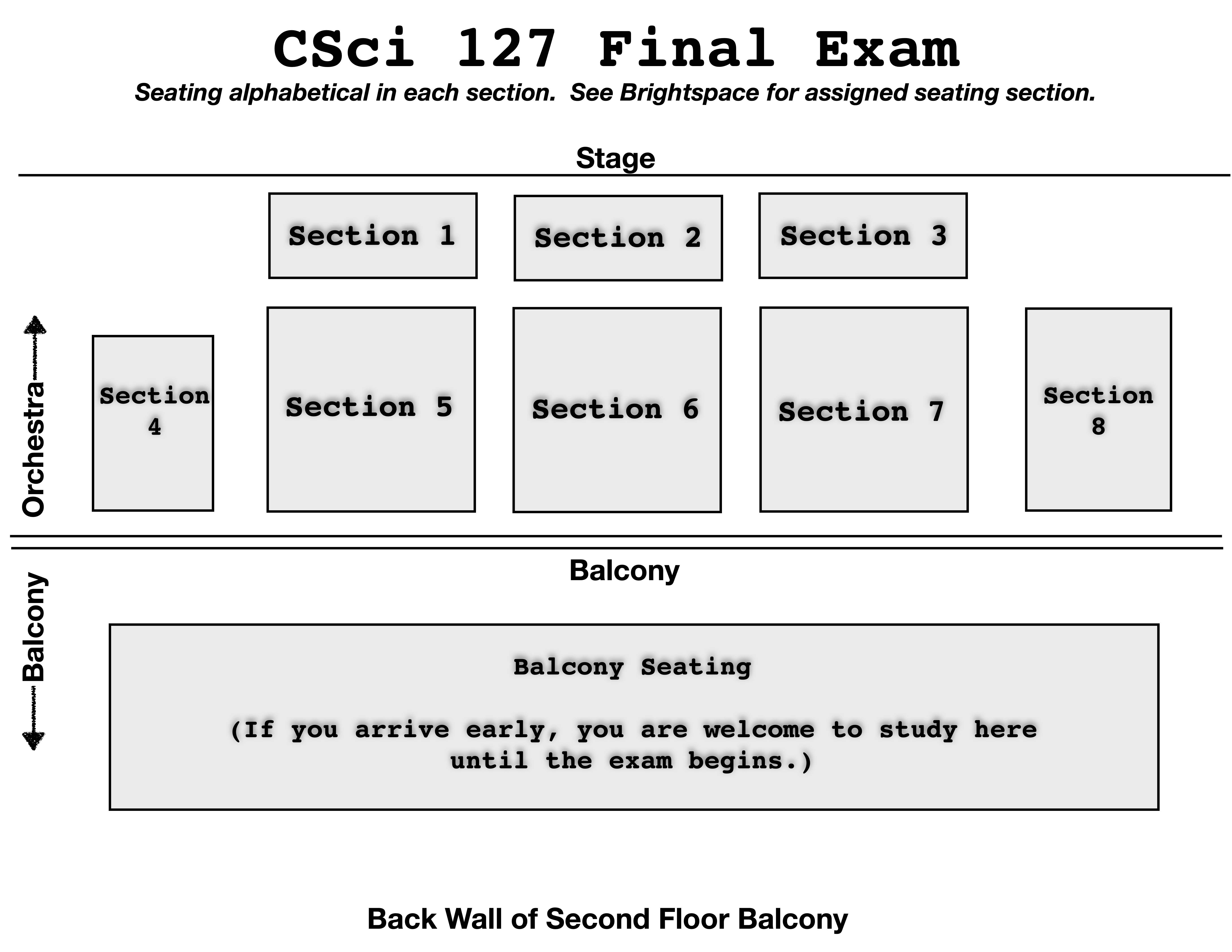
Exam Rules:
- There is a seating chart for the mock (practice) and final exams.
Students will sit in the same section for both the mock and final exams.
See Brightspace for your assigned section the week before the exam. Exams are organized alphabetically in each section. - The exam is closed book and closed notes (except for 1 sheet of notes).
- During the exam:
- When you find your seat, fill in the information sheet.
- You should have with you:
- One 8.5"x11" 2-sided page of notes (no origami, no additional pages).
- Pencils or pens.
- There is no need to have your ID out. We check IDs using the photo course roster that includes your Hunter ID picture.
- Do not open your exam until told to do so.
- No phones, computers, tablets, calculators, watches, smart glasses, smart pencils, earpods, or other electronic devices may be used.
- All electronic devices must be turned off and stored in your bag.
- If you are not able to turn off the Bluetooth/Wifi on your device, put your bag in the front of the room.
- Since we will be scanning the room for active devices, if you have a medical device that uses Bluetooth (e.g. insulin pump, pacemaker), let us know to arrange special accommodations.
- Having an active device is a violation of the exam rules and will be reported to Academic Integrity.
- Besides your one page of notes, all other notes and books must be put away in your bag.
- You must be enrolled in the course to take the exam.
- After everyone is seated and exam has started, the proctors will check you off the photo class roster and collect information sheets.
- To get credit for the exam, you will need to also check out with the proctors as you turn in your exam.
- To minimize confusion, you will need to wait until all exams have been passed out and IDs checked before you can submit your exam.
Exam Format:
On the day of the exam, there will be two parts to fill out:
- Seat Slip: has your name printed on slip. Fill out the remaining information and sign the seat slip.
- Final Exam: make sure to fill out the front page information.
Both the seat slip and the final exam must be submitted.
The final exam has 10 questions, each worth 10 points. The best way to study is to work through the problems we have done throughout the semester. The questions are very similar to the homework, quizzes, examples from lecture, labs, and the reading.
On the last lecture, Tuesday, May 19, we will have a mock final exam. It will be similar to the actual final exam, except that the time will be shorter, since lecture is 1 and 15 minutes while the final exam is 2 hours. An answer key will be available later that afternoon.
How to Prepare:
- Make sure you do all the problems that have been assigned. The problems (or parts of them) make excellent exam questions.
- Work through the past exams. These (or variations of them) often appear on exams.
- While you can print your one page of notes, preparing it by hand is an excellent way to study. Go through each lab and each lecture slides and consolidate your list to fit on a single sheet of paper. Include standard formats or templates for coding constructs and design patterns, as well as samples of recurring themes.
Past Exams
Below are the past exams, along with answer keys. To study for the final exam, choose a past exam and work through it as if you were taking the exam but allow yourself 1 hour (instead of the 2 hours for the real exam). When done, check your answers with the answer key, adjust your note sheet for topics and key ideas that would be useful, and repeat.
- Spring 2026:
- Mock Exam (Version 0): Exam and Answer Key
- Version 1: Exam and Answer Key
- Version 2: Exam and Answer Key
- Version 3: Exam and Answer Key
- Version 4: Exam and Answer Key
- Fall 2025:
- Mock Exam (Version 0): Exam and Answer Key
- Version 1: Exam and Answer Key
- Version 2: Exam and Answer Key
- Version 3: Exam and Answer Key
- Version 4: Exam and Answer Key
- Spring 2025:
- Mock Exam (Version 0): Exam and Answer Key
- Version 1: Exam and Answer Key
- Version 2: Exam and Answer Key
- Version 3: Exam and Answer Key
- Fall 2024:
- Mock Exam: Exam and Answer Key
- Version 01: Exam and Answer Key
- Version 02: Exam and Answer Key
- Spring 2024:
- Mock Exam: Exam and Answer Key
- Version 1 will not be posted.
- Version 2: Exam and Answer Key
- Version 3: Exam and Answer Key
- Fall 2023:
- Mock Exam: Exam and Answer Key
- Version 1: Exam and Answer Key
- Version 2: Exam and Answer Key
- Version 3: Exam and Answer Key
- Spring 2023:
- Mock Exam: Exam and Answer Key
- Version 1: Exam and Answer Key
- Version 2: Exam and Answer Key
- Version 3: Exam and Answer Key
- Fall 2022:
- Mock Exam: Exam and Answer Key in black and white and Answer Key in colors
- Version 1 (white): Exam and Answer Key
- Version 2 (ivory): Exam and Answer Key
- Version 3 (yellow): Exam and Answer Key
- Spring 2022:
- Mock Exam: Exam and Answer Key
- Version 1 (Ivory): Exam and Answer Key
- Version 2 (Pink): Exam and Answer Key
- Version 3 (Green): Exam and Answer Key
- Fall 2021:
- Mock Exam: Exam and Answer Key.
- Version 1 (Yellow): Exam and Answer Key
- Version 2 (Ivory): Exam and Answer Key
- Version 3 (Green): Exam and Answer Key
- Version 4 : Exam and Answer Key
- Fall 2019:
- Mock Exam: Exam and Answer Key.
- Version 1 (Green): Exam and Answer Key
- Version 2 (Purple): Exam and Answer Key
- Version 3 (Blue): Exam and Answer Key
- Spring 2019:
- Mock Exam: Exam and Answer Key.
- Version 1 (Green): Exam and Answer Key
- Version 2 (Purple): Exam and Answer Key
- Version 3 (Blue): Exam and Answer Key
- Fall 2018:
- Mock Exam: Exam and Answer Key
- Version 1 (yellow): exam and answer key
- Version 2 (pink): exam and answer key
- Version 3 (orange): exam and answer key
- Version 4 (green): exam and answer key
- Summer 2018 Exam: Exam and answer key
- Spring 2018:
- Mock Exam: Exam and Answer Key
- Version 1 (green): exam and answer key
- Version 2 (blue): exam and answer key
- Version 3 (purple): exam and answer key
- Fall 2017 Exams:
- Sample Exam: Exam and Answer Key
- Mock Exam: Exam and Answer Key
- Version 1 (yellow): exam and answer key
- Version 2 (green): exam and answer key
- Version 3 (purple): exam and answer key
- Version 4 (blue): exam and answer key