Homework Exercises
CSCI 127: Introduction to Computer Science
Hunter College, City University of New York
Fall 2026
All students registered by Friday, August 28, are sent a Gradescope registration invitation to the email on record on their Brightspace account. If you did not receive the email or would like to use a different account, fill in the form on Brightspace. Include that you not receive a Gradescope invitation, your preferred email, and your EmpID. We will manually generate an invitation. As a default, we use your name as it appears in Brightspace/CUNYFirst (to update CUNYFirst, see changing your personal information). If you prefer a different name for Gradescope, include it, and we will update the Gradescope registration.
General Notes
Learning programming is like learning a foreign language: you will learn more (with less work) if you practice every day. Some of the programs below are easy; some will take more time. We suggest you set aside a block of time most days to work on programming and the course.
The programs build on the concepts and code developed during lecture, lab, and through the reading. Mastery of material is assessed via
- Autograding of the programs submitted to Gradescope,
- The weekly written quizzes with questions about the programs you wrote and concepts from lecture and lab,
- The oral code reviews where, each week, you code a program in IDLE, and
- The paper final exam which covers all material from the semester.
Autograder Notes
The majority of the programs this semester are written in Python (see Lab 1 for getting started with Python); it is noted below when other formats or languages are used. For Python programs, the autograder expects a .py file, using only the specified libraries, and does not accept iPython/Jupyter notebooks. Since all assignments are designed to be uploaded as a single file, the autograder is set up for direct file upload instead of Github. If submitting directly (drop-and-drag onto the webpage), the file name is flexible but must have the extension .py, unless otherwise noted.
Also, to receive full credit, the code should be compatible with Python 3.10 (the default for the Gradescope autograders).
To get full credit for a program, the file must include in the opening comment:
- Your name, as it appears in your Gradescope registration.
- The email you are using for Gradescope.
For example, for the student, Thomas Hunter, his first program might be:
"""
Name:  Thomas Hunter
Email: thomas.hunter1870@hunter.cuny.edu
Date: September 1, 2026
This program prints: Welcome to Fall 2026, Thomas Hunter
"""

print("Welcome to Fall 2026, Thomas Hunter")
For each program, the upper right hand side of the description contains the due date, suggested reading, and, when applicable, the available libraries. When testing your Python programs, the autograder uses Python 3.10 and has available the libraries listed. If the available libraries is none, no additional libraries are used (e.g. no import statement is needed in your program).
You may submit your assignments up to three weeks before the due date and are encouraged to work ahead. To receive credit, assignments must be submitted by the deadline to Gradescope. For more information on using Gradescope, see Lab 1. Since Gradescope gives limited feedback, run your program first locally (on your computer or a lab computer) where the compiler messages will pinpoint errors and help debug your code. For example, if Gradescope gives you a "The autograder failed to execute..." error, it means your program has an error (in this case, it's usually the file contains non-Python commands.). The local Python compiler will give the line of your file with the error, where Gradescope will only say that there's a general problem. For more information on installing Python on your computer, see the installation guides.
Homework Exercises
-
Due Date: 5pm, September 8
Reading: Chapter 1 & Lab 1
Available Libraries: noneHello
Write a program that prints
Welcome tofollowed by the current semester and your name to the screen. For example, if your name isThomas Hunter, when your program is run, it would print:Welcome to Fall 2026, Thomas Hunter
-
Due Date: 5pm, September 9
Reading: Chapter 4 & Lab 1
Available Libraries: turtleTriangle
Write a program that draws a triangle using the
turtlelibrary.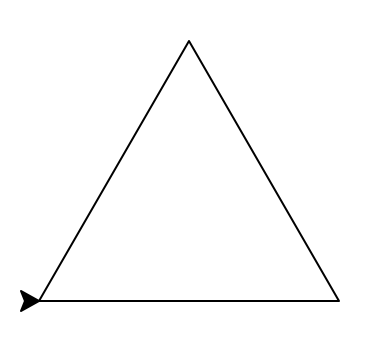
Notes:- Whenever submitting a turtle program, choose a name for your file that is not turtle.py. When executing the
import turtlestatement, the computer first looks in the folder where the file is saved for the turtle module and then in the libraries (and other places on the path). If you name your file turtle.py, it thinks the module is itself, causing all kinds of errors. To avoid this, name your program something like myTurtle.py or program2.py. - For testing purposes we only support the following subset of turtle commands:
Please use ONLY these commands in your programs.backward, color, colormode, forward, goto, hideturtle, home, left, pendown, penup, pensize, right, shape, showturtle, speed, stamp
- Whenever submitting a turtle program, choose a name for your file that is not turtle.py. When executing the
-
Due Date: 5pm, September 10
Reading: Chapter 4 & Lab 1
Available Libraries: turtleTurtle Drawing
Write a program to draw your dream home using turtles. The initial part of the code is provided. This must be your own design and, as with all programs, you must be the author of your own code and do your own typing.
You can let your imagination free, the only requirements are:- you must use at least 6 different colors
- your turtle must walk at least 2000 steps
"""
Your Name
Your Email
"""
import turtle

t = turtle.Turtle()
t.hideturtle() # Hide the turtle

"""
TODO: finish the rest of the program to draw your dream home
Requirements:  Use at least 6 different colors and walk at least 2000 steps
"""
Note: For testing purposes we only support the following subset of turtle commands
Please use ONLY these commands in your programs.backward, color, colormode, forward, goto, hideturtle, home, left, pendown, penup, pensize, right, shape, showturtle, speed, stamp
-
Due Date: 5pm, September 14
Reading: Chapter 1 & Lab 1
Available Libraries: noneMultiple Greetings
Write a program that will print Welcome! multiple times. The number of times depends on your EmplID number. Take the last 2 digits of your EmplID number and add 10. For example, if your EmplID ends in 13, the number of times you repeat the message is 13+10 = 23.
For example, with an EmplID ending in 02, you would repeat the message 12 times:
Welcome!
Welcome!
Welcome!
Welcome!
Welcome!
Welcome!
Welcome!
Welcome!
Welcome!
Welcome!
Welcome!
Welcome!
-
Due Date: 5pm, September 15
Reading: Chapter 4 & Lab 1
Available Libraries: turtleFlower
Write a program that implements the pseudocode ("informal high-level description of the operating principle of a computer program or other algorithm") below:
"""
Your Name
Your Email
"""
import turtle

t = turtle.Turtle()
t.speed(0)     # Set the turtle's speed to 0 (fastest)
t.pensize(2)   # Set the turtle's pen size to 2
t.hideturtle() # Hide the turtle

"""
TODO: implement the following pseudocode:
Repeat 25 times:
  Repeat 2 times:
    Change the color to purple.
    Walk forward 100 steps.
    Turn left 144 degrees.
    Change the color to orange.
    Walk forward 100 steps.
    Turn right 36 degrees.
  Turn right 25 degrees.
"""
Your output should look like this:

Note: For testing purposes we only support the following subset of turtle commands:
Please use ONLY these commands in your programs.backward, color, colormode, forward, goto, hideturtle, home, left, pendown, penup, pensize, right, shape, showturtle, speed, stamp -
Due Date: 5pm, September 16
Reading: Chapter 2 & Lab 2
Available Libraries: noneUpper & Lower
Using the string commands introduced in Lab 2, write a Python program that prompts the user for a message, and then prints the message, the message in lower case letters, and the message in upper case letters.
A sample run of your program should look like:
Enter a message:  Mihi cura futuri
Mihi cura futuri
mihi cura futuri
MIHI CURA FUTURI
Another run:
Enter a message:  I love Python!
I love Python!
i love python!
I LOVE PYTHON!
Hint: Your program should be able to take any phrase the user enters and prints it, prints it in lower case letters, and prints it in upper case letters. To do that, you need to store the phrase in a variable and print variations of the stored variable. See "More Useful String Methods" in Lab 2.
-
Due Date: 5pm, September 17
Reading: Chapter 2 & Lab 2
Available Libraries: noneLowercase ASCII
Write a program that prompts the user to enter a phrase, converts the phrase to lowercase, and then prints out each lowercase character and its corresponding ASCII code.
A sample run of your program should look like:
Enter a phrase: abc
a 97
b 98
c 99
And another sample run:
Enter a phrase: ABC
a 97
b 98
c 99
Another run, with a longer phrase:
Enter a phrase:  I love Python!
i 105
  32
l 108
o 111
v 118
e 101
  32
p 112
y 121
t 116
h 104
o 111
n 110
! 33
Hint: The first step is to ask the user for input (see Section 2 of Lab 2). If c is a character,
ord(c)returns its ASCII code. For example, if c is 'i', thenord(c)returns 105. See Lab 2 for more on ASCII and characters. -
Due Date: 5pm, September 18
Reading: Chapter 4 & Lab 2
Available Libraries: turtleSparkle
Write a program, using the turtle library, that implements the pseudocode below:
Set the speed to 0.
Set the pen size to 1.
Hide the turtle.

For i = 20, 24, 28, ..., 200:
  Change the color to "cyan"
  Walk forward i steps
  Turn left 90 degrees
  Change the color to "gold"
  Walk forward i steps
  Turn right 185 degrees
Your output should look similar to:

Notes:
- Use
range()with a step parameter to generate every other number. See examples ofrange(start,stop,step)in Section 4 of Lab 2. - For testing purposes, only a subset of turtle commands is supported (as noted in earlier programs):
Please use ONLY these commands in all turtle programs. This reminder will not be repeated in future turtle programs, but it applies to all of them.backward, color, colormode, forward, goto, hideturtle, home, left, pendown, penup, pensize, right, shape, showturtle, speed, stamp
- Use
-
Due Date: 5pm, September 22
Reading: Chapter 2 & Lab 2
Available Libraries: noneAcronyms
Write a program that prompts the user for a phrase and creates an acronym, consisting of the first letters of each word, in uppercase.
To approach a problem, it is useful to break it into steps:
- Prompt for a phrase & read it into a variable.
- Make the phrase upper case.
- Print the phrase.
- Split up the phrase into words.
- Take the first letter of each word (keep in mind that split() returns a list of the words ), concatenate and make an acronym of it.
- Print the acronym.
Now translate the above pseudocode (informal but detailed description of the steps in a program) into python and test that your program works as follows:
Enter a phrase:  City University New York
Your phrase in capital letters:  CITY UNIVERSITY NEW YORK
Acronym:  CUNY
And another run:
Enter a phrase:  Hunter College
Your phrase in capital letters:  HUNTER COLLEGE
Acronym:  HC
Hint: See examples of looping through strings in Section 4 of Lab 2.
-
Due Date: 5pm, September 23
Reading: Chapter 4 & Lab 3
Available Libraries: turtleShades of Pink
Modify the program from Lab 3 to show the shades of pink.
Hint: think about which combined pair in (red, green, blue) might give you the color pink.Your output should look similar to:

-
Due Date: 5pm, September 24
Reading: Chapter 2 & Lab 2
Available Libraries: noneWord Count
Write a program that asks the user for a phrase, and prints out the number of words in the phrase. Your program should repeat this for 4 more phrases (a total of 5 phrases):
The output of your program should be:
Enter phrase: This is my letter to the World
7
Enter phrase: That never wrote to Me-
5
Enter phrase: The simple News that Nature told-
6
Enter phrase: With tender Majesty
3
Enter phrase: Emily Dickinson
2
-
Due Date: 5pm, September 25
Reading: Chapter 2 & Lab 2
Available Libraries: noneSkip-and-double shopping
Write a program that:
- Prompts the user to enter a comma-separated shopping list
- Splits the input into individual items
- Prints every 2nd item starting with the second item
- Each selected item should be printed twice on its own line
A sample run of your program should be:
Enter a shopping list: Apples,bananas,carrots,apple pie,eggs,figs,grapes,honey,kiwi
bananas bananas
apple pie apple pie
figs figs
honey honey
Hint: Use
split()to break the string into a list of words, then userange()with a step parameter to access every 2nd item andlen()to get the length of the list as stop parameter. See examples ofrange(start,stop,step)in Section 4 of Lab 2.Match the prompt used above exactly (e.g. "Enter a shopping list: ").
-
Due Date: 5pm, September 28
Reading: Chapter 2, Chapter 4 & Lab 3
Available Libraries: turtleColor Stamps
Write a program that asks the user for a color in hexadecimal notation, moves a turtle forward 20 steps, and then stamps out a turtle shape that color. Your program should repeat this for 4 more colors in hexadecimal notation (a total of 5 turtle stamps and moves forward).
For example, if you ran your program and the user entered:
Enter color (as hex): #0000FF
Enter color (as hex): #0000B8
Enter color (as hex): #000087
Enter color (as hex): #000043
Enter color (as hex): #000011
The output would be:

-
Due Date: 5pm, September 29
Reading: Section 2.8, Chapter 4, Lab 2 & Lab 4
Available Libraries: turtleTurning Turtle
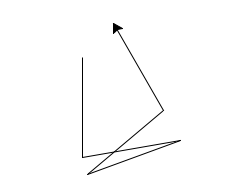
Write a program that asks the user for 5 whole (integer) numbers. For each number, turn the turtle left the degrees entered and then the turtle should move forward 100.
A sample run of your program should look like:
Enter a number: 270
Enter a number: 100
Enter a number: 190
Enter a number: 200
Enter a number: 80
and the output should look similar to:
-
Due Date: 5pm, September 30
Reading: Lecture 2 & Chapter 2
Available Libraries: noneCaesar Cipher
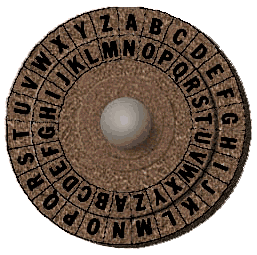
(The cipher disk above shifts 'A' to 'N', 'B' to 'O', ... 'Z' to 'M', or a shift of 13. From secretcodebreaker.com)Write a program that prompts the user to enter a word and the amount to shift, and then prints out the word with each letter shifted right by that amount. For example, if the shift was 13 (as in the figure above), then, 'a' becomes 'n', 'b' becomes 'o', ... 'y' becomes 'l', and 'z' becomes 'm'.
Assume that all inputted words are in lower case letters: 'a',...,'z'.
A sample run of your program should look like:
Enter an all-small-letter string: zebra
Enter a non-negative int to shift: 13
Encoded string: mroen
Here is another sample run of your program.
Enter an all-small-letter string: owqfka
Enter a non-negative int to shift: 6
Encoded string: ucwlqg
Hint: See the example programs from Lecture 2.
-
Due Date: 5pm, October 1
Reading: Lecture 3, Section 9.7 & Lab 2
Available Libraries: noneSlicing Loop
Implement the following piece of pseudocode as a complete program:1. Prompt the user to enter a string and call it s. 2. Let ls be the length of s. 3. For i in 0, 1, ..., ls-1: 4. Print s[:i] 5. For i in 0, 1, ..., ls-1: 6. Print s[i:] 5. Print a closing statement
A sample run of your program should look like:
Enter string: a man a plan a canal panamawhich would output:
a
a
a m
a ma
a man
a man
a man a
a man a
a man a p
a man a pl
a man a pla
a man a plan
a man a plan
a man a plan a
a man a plan a
a man a plan a c
a man a plan a ca
a man a plan a can
a man a plan a cana
a man a plan a canal
a man a plan a canal
a man a plan a canal p
a man a plan a canal pa
a man a plan a canal pan
a man a plan a canal pana
a man a plan a canal panam
a man a plan a canal panama
man a plan a canal panama
man a plan a canal panama
an a plan a canal panama
n a plan a canal panama
a plan a canal panama
a plan a canal panama
plan a canal panama
plan a canal panama
lan a canal panama
an a canal panama
n a canal panama
a canal panama
a canal panama
canal panama
canal panama
anal panama
nal panama
al panama
l panama
panama
panama
anama
nama
ama
ma
a

Thank you for using my program!
-
Due Date: 5pm, October 2
Reading: Chapter 2, Chapter 7 & Lab 4
Available Libraries: noneDNA
We can store DNA sequences as strings. These strings are made up of the letters A, C, G, and T. For a given DNA string, the GC-content is the percent of the string that is C or G, written as a decimal.
Write a program that prompts the user for a DNA string, and then prints the length and GC-content of that string.
A sample run of the program:
Enter a DNA string:  ACGCCCGGGATG
Length is 12
GC-content is 0.75
Hint: See Lab 4. You can use a for-loop to go through each character in the string, and count each time you encounter a 'C' or 'G'. You can use an if-statment to check what kind of character the loop is currently on. Alternatively, you can use the count() method introduced in Lab 2 to get the total occurrences of 'C' and 'G' in the string.
-
Due Date: 5pm, October 5
Reading: Section 8.11, Lab 4 & Numpy Tutorial
Available Libraries: numpy, matplotlibLogo
Write a program that creates a 'U' logo for university on a 30x30 grid. Your program should ask the user for the red, green, and blue for the color of their logo, and the file to save the image.
A sample run using Hunter College Purple (Pantone 267):
The resulting file is:Enter amount of red: 0.373 Enter amount of green: 0.145 Enter amount of blue: 0.624 Enter file name: hunterPurple_U.png
The grading script is expecting:
- The grid to be 30 x 30.
- The color of the 'U' is the amount of red, blue, and green specified, as a value between 0 and 1.0.
- The left side of the 'U' should be the left third of the image; the bottom part of the 'U' should be the bottom third of the image; and the right part of the 'U' should be the the right third of the image.
- The remaining pixels in the image should be white (100% red, 100% green, and 100% blue).
Note: before submitting your program for grading, remove the commands that show the image (i.e. the ones that pop up the graphics window with the image). The program is graded on a server on the cloud and does not have a graphics window, so, the
plt.show()andplt.imshow()commands will give an error. Instead, the files your program produces are compared pixel-by-pixel to the answer to check for correctness. -
Due Date: 5pm, October 6
Reading: Section 8.11, Lab 4 & Numpy Tutorial
Available Libraries: matplotlib, numpyTopographic Map
Modify the map-making program from Lab 4 to color the map based on elevation:
- If the elevation is less than or equal to zero, color blue.
- For elevation larger than zero but less than or equal to the Sandy storm surge (6 feet), set color to be orange (100% red, 50% green, 0% blue).
- For elevation just above the Sandy storm surge (6 feet) and less than or equal to 13 feet, set color to be light grey (25% red, 25% green, 25% blue).
- For elevation just above 13 feet but less than or equal to 20 feet, set color to be dark grey (75% red, 75% green, 75% blue).
- For elevation that is above 20, set color to be light green (0% red, 100% green, 50% blue).
Your resulting map should look like:

and be saved to a file called black_outline_topo.png.
Note: before submitting your program for grading, remove the commands that show the image (i.e. the ones that pop up the graphics window with the image). The program is graded on a server on the cloud and does not have a graphics window, so, the
plt.show()andplt.imshow()commands will give an error. Instead, the files your program produces are compared pixel-by-pixel to the answer to check for correctness. -
Due Date: 5pm, October 7
Reading: Section 10.23, Chapter 4 & Lab 4
Available Libraries: noneTwo-Part Numbers
Write a program that identifies all two-part numbers from a string and returns a list of those numbers. In the input string, each number is separated by a comma followed by a space: ', ', and two-part numbers contain a '-'.
For example, if you ran your program and the user entered:
Enter numbers, separated by commas: twenty, four, thirty-one, sixty-six, eight
A list of the two-part numbers:  ["thirty-one", "sixty-six"]
Hint: See Section 4 in Lab 4.
-
Due Date: 5pm, October 8
Reading: Lab 4 & Numpy Tutorial
Available Libraries: matplotlib, numpyGrayscale Image
Write a program that asks the user for a name of an image .png file and the name of an output file. The program then converts the image to grayscale and saves the grayscale image to the specified output file.
There are many ways to convert color images to grayscale (see Grayscale Algorithms for a nice overview).
For this program, we are setting each channel of a pixel to its green value. That is, your program should set the red channel values to the green channel values, as well as the blue channel values to the green channel values. For example, a single pixel at(i,j)of the imageimgwould be changed to:img[i,j,0] = img[i,j,1] #change value of red channel to value of green channel img[i,j,2] = img[i,j,1] #change value of blue channel to value of green channelA sample run of your program should look like:
Enter name of the input file:  csBridge.png
Enter name of the output file:  gray_bridge.png
The sample input file and the resulting grayscale image:
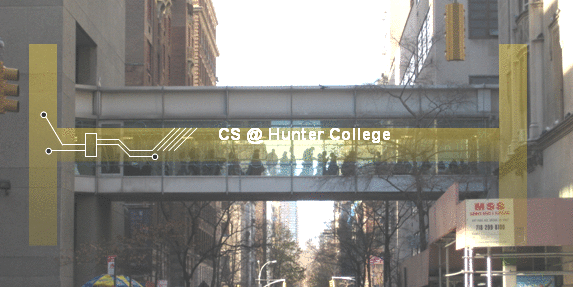
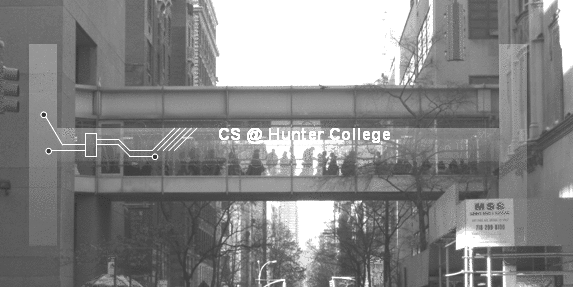
Note: before submitting your program for grading, remove the commands that show the image (i.e. the ones that pop up the graphics window with the image). The program is graded on a server on the cloud and does not have a graphics window, so, the
plt.show()andplt.imshow()commands will give an error. Instead, the files your program produces are compared pixel-by-pixel to the answer to check for correctness.Hint: See Lab 3. Think about how you can uses numpy slices to change every pixel.
-
Due Date: 5pm, October 9
Reading: Burch's Logic & Circuits & Lab 5
Available Libraries: N/AXOR Circuit
Build a circuit that has the same behavior as an xor gate (i.e. true only when exactly one input is true) using only and, or, and not gates.
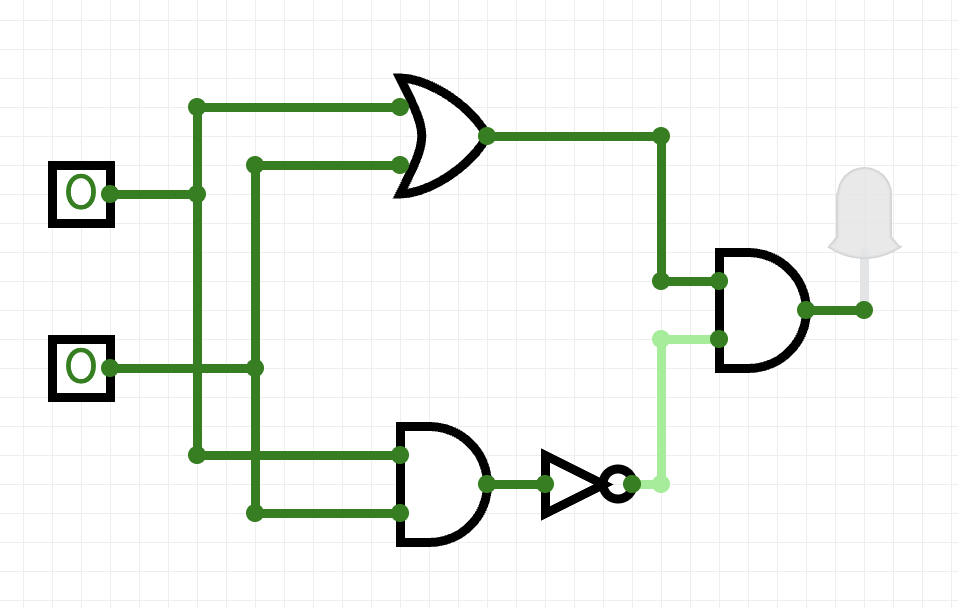
Save your expression to a text file. See Lab 5 for the format for submitting logical expressions to Gradescope.
-
Due Date: 5pm, October 14
Reading: Burch's Logic & Circuits & Lab 5
Available Libraries: N/AMajority Circuit
Write a logical expression that is equivalent to the circuit that computes the majority of 3 inputs, called in1, in2, in3:
- If two or more of the inputs are True, then your expression should evaluate to True.
- Otherwise (two or more of the inputs are False), then your expression should evaluate to False.
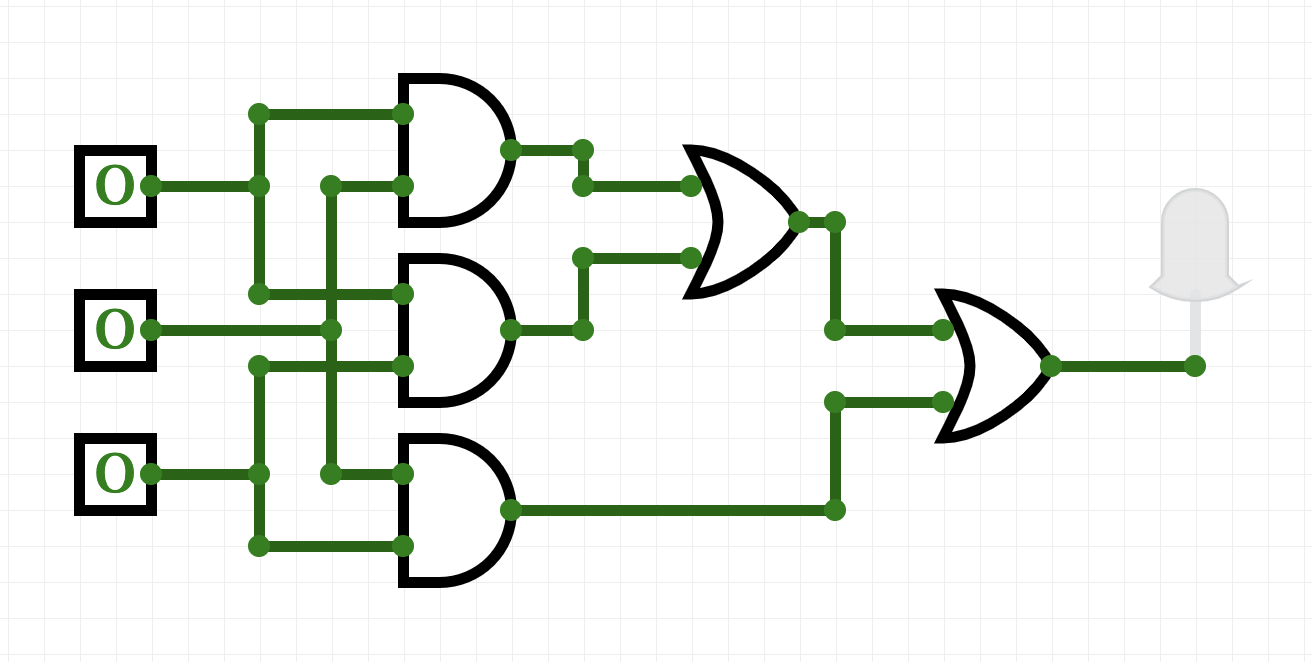
Save your expression to a text file. See Lab 5 for the format for submitting logical expressions to Gradescope.
Hint: See Lab 5.
-
Due Date: 5pm, October 15
Reading: Chapter 7 & Lab 4
Available Libraries: turtleTurtle String
- 'F': moves the turtle forward 50 steps
- 'L': turns the turtle 90 degrees to the left
- 'R': turns the turtle 90 degrees to the right
- '^': lifts the pen
- 'v': lowers the pen
- 'a': change the shape to arrow
- 'q': change the shape to square
- 'r': change the pen color to red
- 'b': change the pen color to blue
- 'B': move the turtle backward 50 steps
- 'M': change the pen size to 8 (Mega pen)
- 'm': change the pen size to 1 (micro pen)
-
Due Date: 5pm, October 16
Reading: Burch's Logic & Circuits & Lab 5
Available Libraries: N/ABinary Number Incrementer
Logical gates can be used to do arithmetic on binary numbers. For example, we can write a logical circuit whose output is one more than the inputted number. Our inputs are in1 and in2 and the outputs are stored in out1, out2, and out3.
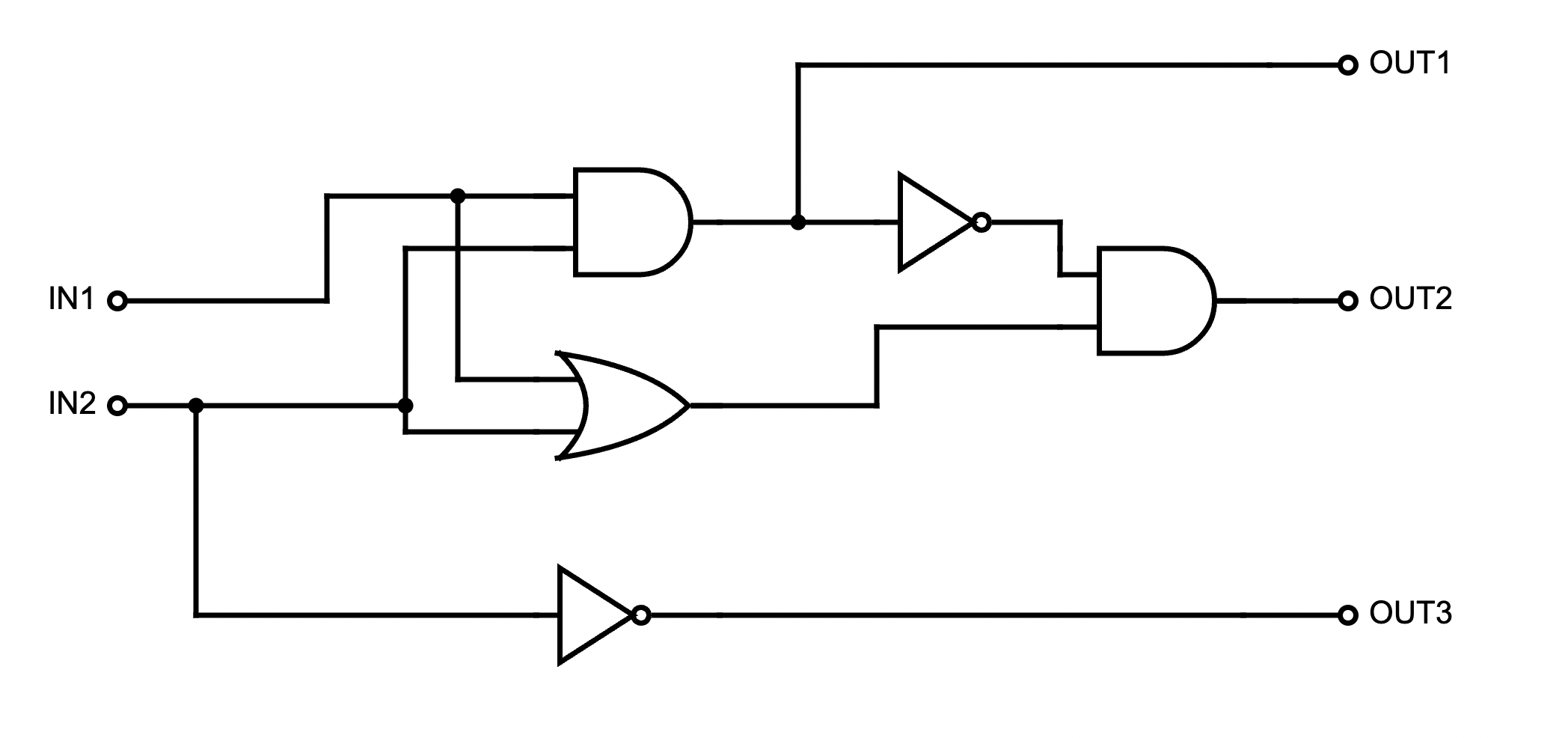
Here is a table of the inputs and outputs:
Inputs Outputs Decimal
Numberin1 in2 Decimal
Numberout1 out2 out3 0 0 0 1 0 0 1 1 0 1 2 0 1 0 2 1 0 3 0 1 1 3 1 1 4 1 0 0 Submit a text file with each of the outputs on a separate line:
"""
Name:  YourNameHere
Date:  March 2025
Logical expressions for a 4-bit incrementer
"""

out1 = ...
out2 = ...
out3 = ...
Where "..." is replaced by your logical expression (see Lab 5 for hints and formatting help).Note: here's a quick review of binary numbers.
-
Due Date: 5pm, October 19
Reading: Lecture 4, Lab 4
Available Libraries: noneNoise Exposure Safety
Write a program that asks the user for a noise level in decibels (dB) and the number of hours of exposure (asks for two input values).
Based on NIOSH/OSHA guidelines, the maximum safe exposure time decreases as noise level increases:- Between 0 and 85 dB (inclusive), the safe limit is up to 8 hours.
- Between 86 and 88 dB (inclusive), the safe limit is up to 4 hours.
- Between 89 and 91 dB (inclusive), the safe limit is up to 2 hours.
- Between 92 and 94 dB (inclusive), the safe limit is up to 1 hour.
- Above 94 dB, no duration of exposure is considered safe.
The program should print "Safe" when the number of hours is within the limit for the noise level. It should print "Caution" when the number of hours is above the limit for the noise level. It should print "Unsafe" whenever the noise level is above 94dB.Sample runs:
Enter noise level in decibels: 87
Enter hours of exposure: 3
Safe
Enter noise level in decibels: 87 Enter hours of exposure: 6 CautionEnter noise level in decibels: 97 Enter hours of exposure: 1 UnsafeNote: "inclusive" for a range of numbers means that it includes the endpoints. For example, "between 4 and 8, inclusive" means all values that are greater than or equal to 4 and are also less than or equal to 8.
-
Due Date: 5pm, October 20
Reading: 10-mins to Pandas, DC Pandas, Lab 6
Available Libraries: pandasMinimal Temperatures
In Lab 6, we wrote a program that computed the average rainfall from Australian weather data. Modify the program to ask the user for the name of a CSV file and then to print out, using the data from the CSV file:
- The lowest temperature recorded across all locations and dates.
- The lowest temperature for each location across all dates.
For example, running the program on rain_A.csv (a smaller version of the CSV file from the lab that's contains only the cities that start with 'A'):
Enter CSV file name: rain_A.csv Overall min temp: -5.2 Minimum temperature by location: Location Adelaide 0.7 Albany 1.8 Albury -2.8 AliceSprings -5.2 -
Due Date: 5pm, October 21
Reading: 10-mins to Pandas, DC Pandas, Lab 6
Available Libraries: pandasFuel Cost Estimator
Using pandas, write a program that asks the user for a trips file, in comma separated value (CSV) format, reads in the corresponding CSV file, calculates the fuel cost for each trip, and prints out the data with a new column named Fuel_Cost showing the cost in dollars. Assume that the CSV files have the columns: "Trip", "Distance_miles", "MPG", and "Price_per_gallon". MPG stands for miles per gallon, i.e. how many miles the car travels on one gallon of fuel. The fuel cost for a trip is calculated as:
Fuel_Cost = Distance_miles / MPG * Price_per_gallon
For example if the CSV file, trips.csv, contained:
Trip Distance_miles MPG Price_per_gallon NYC to Boston 215 30 3.50 NYC to Philadelphia 95 30 3.45 NYC to Washington DC 225 28 3.55 NYC to Albany 150 32 3.40 A sample run of your program would be:
Enter trips file name: trips.csv Fuel costs: Trip Distance_miles MPG Price_per_gallon Fuel_Cost 0 NYC to Boston 215 30 3.50 25.083333 1 NYC to Philadelphia 95 30 3.45 10.925000 2 NYC to Washington DC 225 28 3.55 28.526786 3 NYC to Albany 150 32 3.40 15.937500 -
Due Date: 5pm, October 22
Reading: GitHub Guide, Lab 6
Available Libraries: N/AGitHub
In Lab 6, you created a GitHub account. Submit a text file with the name of your account. The grading script is expecting a file with the format:
"""
Name:  Your_name
Email: Your_eamil
Account name for my GitHub account
""""

AccountNameGoesHere
Note: it takes a few minutes for a newly created GitHub account to be visible. If you submit to Gradescope and get a message that the account doesn't exist, wait a few minutes and try again.
-
Due Date: 5pm, October 23
Reading: Lab 6, Ubuntu Terminal
Available Libraries: N/AHello (Shell Script)
Write a shell script that prints Hello, Shell to the screen.
Submit a single text file containing your Unix shell commands. See Lab 6 for details.
Note: for comments, shell scripts use # in front of lines (instead of the block comments surrounded by """ """) and the first line is the "shebang" line. For a proper shell script, your file should start:
#!/bin/bash
#Name:  YourNameHere
#Email: YourEmailHere
-
Due Date: 5pm, October 26
Reading: Lab 7 & Section 6.8
Available Libraries: noneHello Two Ways
Write a Python program that contains a function called, main(). Your function should print out a greeting to you by name. For example, if your name is Thomas Hunter, invoking main() would print:
Hello, Thomas HunterYou should use conditional execution, so your file can be run as a standalone program or imported so the function can be used elsewhere.
To test your program, we will run it two ways:
- We will run it as a stand-alone program and see that it outputs the greeting. If your program is called,
student.py, then we would run it,python3 student.py, to see that it prints the greeting. - We will import your file and directly call the function. If your program is called,
student.py, we would import it into a Python program,import student, and in that program, call your function,student.main(), to see that it prints the greeting.
Note: your function MUST be called main()
Hint: See Section 4 of Lab 7 for details on conditional execution.
- We will run it as a stand-alone program and see that it outputs the greeting. If your program is called,
-
Due Date: 5pm, October 27
Reading: Think CS Chapter 6, Chapter 7, Lab 5, Lab 8 & Numpy Tutorial
Available Libraries: matplotlib, numpyCounting Pixels Near a Color
Write a function count_pixels_near_color(filename, r, g, b, tolerance) that takes the filename of an image, a target color given as red, green, and blue values, and a tolerance value. The function returns the number of pixels where each channel is within tolerance of the corresponding target value. That is, a pixel at position (i,j) is counted if:
- the absolute difference between the pixel's red channel and r is less than or equal to tolerance,
- the absolute difference between the pixel's green channel and g is less than or equal to tolerance, and
- the absolute difference between the pixel's blue channel and b is less than or equal to tolerance.
Note on image values: When reading a PNG file with plt.imread(), pixel values are returned as floats between 0 and 1. To compare them to the target color values (which are between 0 and 255), you will need to multiply each channel by 255 first.
An example, using the file pink_landscape.png as the input file:
image credits craiyon.com
the following code, using your function:
count = count_pixels_near_color('pink_landscape.png', 200, 100, 100, 50)
print(count)
will output
72488In another example, using the file green_landscape.png as the input file:
image credits craiyon.com
the following code, using your function:
count = count_pixels_near_color('green_landscape.png', 200, 100, 100, 50)
print(count)
will output
0Note: The grading script does not run the whole program, but instead tests your function separately ('unit tests') to determine correctness. As such, the function name must match exactly (else, the scripts cannot find it). Before submitting your program for grading, remove any commands that are outside a function definition. To test the function you wrote, we import your file and then call the function directly. Code outside of function definitions will give compilation errors and prevents the tests from completing (giving a grade of 0). If you have extra code for testing and such, either comment it out before submitting, or use conditional execution (see Lab 7).
Hint: See Section 2 of Lab 5, Snow Pack in California, for an example of counting pixels.
-
Due Date: 5pm, October 28
Reading: 10-mins to Pandas, DC Pandas, Lab 7
Available Libraries: pandasVideo Game Sales Analysis
The file vgsales.csv contains data on video game sales. Each row represents a game and includes its title, platform, release year, genre, publisher, and sales figures across different regions.
Step 1: Create Your Personalized Dataset (IDfiltered_vgsales.csv)
Before writing your program, you must filter vgsales.csv to create a dataset unique to you. Use the last two digits of your EmplID number to determine a 10-year window of data to keep:
- Take the last two digits of your EmplID number. Call this number NN.
- Compute your start year:
start_year = 1980 + (NN % 30) - Your year window is start_year to start_year + 9 (inclusive).
- Filter vgsales.csv to keep only rows where the Year falls within your window.
- Save the result as IDfiltered_vgsales.csv.
Example: If your EmplID number is 54034766, the last two digits are 66.
start_year = 1980 + (66 % 30) = 1980 + 6 = 1986
You keep only rows where Year is between 1986 and 1995 (inclusive).
Your output file would be named IDfiltered_vgsales.csv.You can filter and save the CSV using pandas. Assuming the dataframe in which you read vgsales.csv is called df:
filtered = df[(df['Year'] >= start_year) & (df['Year'] <= start_year + 9)]
filtered.to_csv('IDfiltered_vgsales.csv', index=False)
Step 2: Write Your Program (hw33.py)
Adapt the parking ticket program from Lab 7 to analyze video game sales data. Your program should:
- Ask the user for the name of the input CSV file.
- Ask the user for a platform to filter by (e.g.,
PS4,Wii,X360). - Ask the user for the attribute (column name) to analyze.
- Display the top 5 values for that attribute among games on the chosen platform.
Valid attributes the user may enter:
Genre- Genre of the game (Action, Sports, etc.)Publisher- Publisher of the gameYear- Year the game was released
Hint: To select only the rows where a column matches a specific value, you can use the following pattern:
This creates a new dataframe filtered containing only the rows where the Platform column equals the value stored in platform.filtered = df[df['Platform'] == platform]A sample run:
Enter CSV file name: vgsales.csv
Enter platform: PS4
Enter attribute: Genre
The top 5 values for Genre on PS4 are:
Genre
Action           31
Role-Playing     28
Sports           19
Shooter          13
Adventure        10
Name: count, dtype: int64
And another run:
Enter CSV file name: vgsales.csv
Enter platform: Wii
Enter attribute: Publisher
The top 5 values for Publisher on Wii are:
Publisher
Ubisoft             51
Activision          12
Electronic Arts     10
Nintendo            9
THQ                 8
Name: count, dtype: int64
Note: The values shown above are for a particular EmplID and year range. Your output will differ since each student's filtered dataset is unique.
Submission: Submit (upload) the following two files to Gradescope:
- hw33.py: your Python program
- IDfiltered_vgsales.csv: your personalized filtered CSV file (where ID is your EmplID number)
-
Due Date: 5pm, October 29
Reading: Section 6.8 & Lab 7
Available Libraries: turtleColor Square Spiral
Write a program, using function main() that implements the following pseudocode.
Note: the pseudocode refers to the body of the function and does not illustrate the function definition.""" TODO: implement the following pseudocode inside a main() function: Create a turtle Set the turtle's speed to 0 Set the turtle's pen size to 2 Hide the turtle Create a list with ["purple", "gold", "cyan", "lime"] repeated 25 times Create a list with the numbers 10, 15, 20, ..., 105, followed by 110, 105, ..., 15 Zip the two lists For each color and distance in the zipped lists: Set the turtle's color to the current color Move forward by the current distance Turn right 90 degrees """Hints:
- You can repeat a list using
*. Example:[1, 2] * 3creates[1, 2, 1, 2, 1, 2] - Use
list(range(start, stop, step))to create a list of numbers. Example:list(range(10, 30, 5))creates[10, 15, 20, 25] - Two lists can be combined using
+. Example:[1, 2, 3] + [3, 2, 1]creates[1, 2, 3, 3, 2, 1] - Use
zip()to pair elements from two lists together. See Lab 7 Section 2
Your output should look like this:

- You can repeat a list using
-
Due Date: 5pm, October 30
Reading: Section 7.4, Lab 4, Lab 7 and Lab 8
Available Libraries: noneHTTP Status Code
Write the function status_to_message(code) which takes an HTTP status code as an integer and returns the corresponding message as a string.
- If the code does not correspond to a known status code, your function should return "Unknown".
- Use the following status codes:
200: OK
201: Created
301: Moved Permanently
302: Found
400: Bad Request
401: Unauthorized
403: Forbidden
404: Not Found
418: I'm a Teapot
500: Internal Server Error
503: Service Unavailable
A sample call of the function:
print("Status 404:", status_to_message(404))would print:
Status 404: Not FoundAnd another example call of the function:
code = 201
print("Status", code, ":", status_to_message(code))
would print:
Status 201 : CreatedAnd an invalid input example:
print("Status 999:", status_to_message(999))would print:
Status 999: UnknownNote: The grading script does not run the whole program, but instead tests your function separately ('unit tests') to determine correctness. As such, the function name must match exactly (else, the scripts cannot find it). Before submitting your program for grading, remove any commands that are outside a function definition. To test the function you wrote, we import your file and then call the function directly. Code outside of function definitions will give compilation errors and prevents the tests from completing (giving a grade of 0). If you have extra code for testing and such, either comment it out before submitting, or use conditional execution (see Lab 7).
Hint: See Lecture 8 for related programs.
-
Due Date: 5pm, November 2
Reading: Think CS Chapter 6, Lab 4, Lab 8, & Numpy Tutorial
Available Libraries: matplotlib, numpyAveraging Images
Fill in the missing functions:
- average(region): Takes a region of an image and returns the average red, green, and blue values across the region.
- setRegion(region,r,g,b): Takes a region of an image and red, green, and blue values, r, g, b. Sets the region so that all points have red values of r, green values of g, and blue values of b.
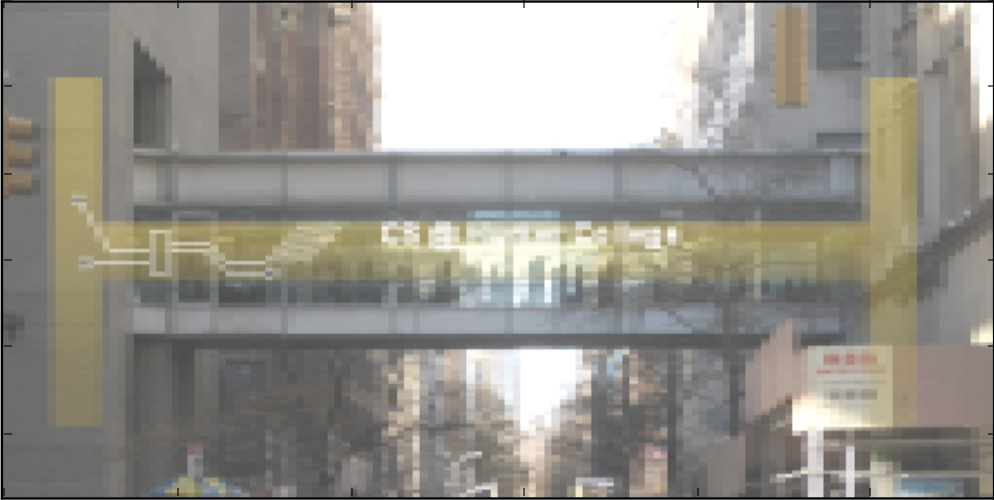
The functions are part of a program that averages smaller and smaller regions of an image until the underlying scene is visible (inspired by the elegant koalas to the max).
For example, if you inputted our favorite image, you would see (left to right):


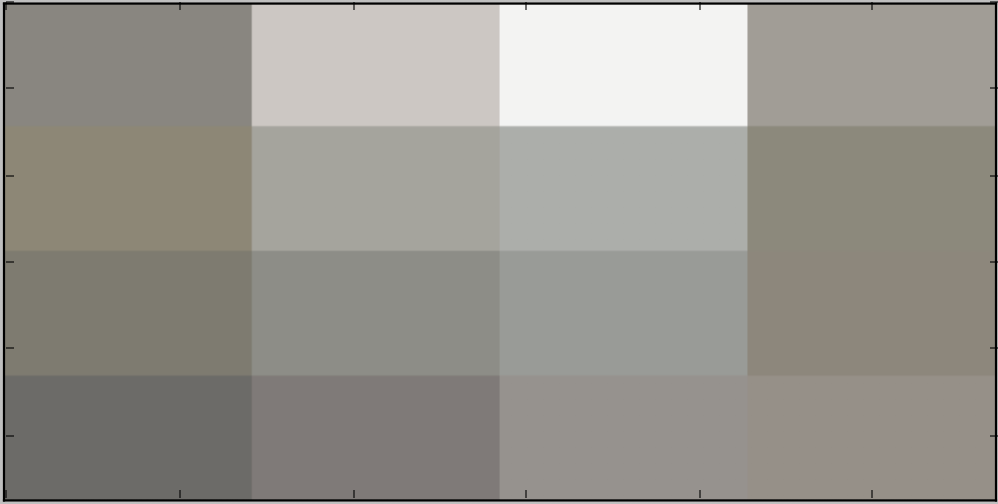

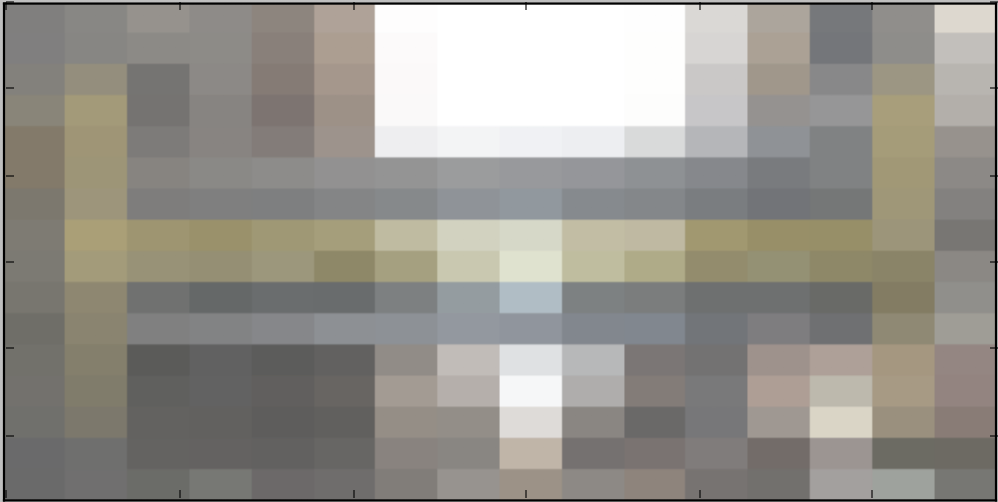

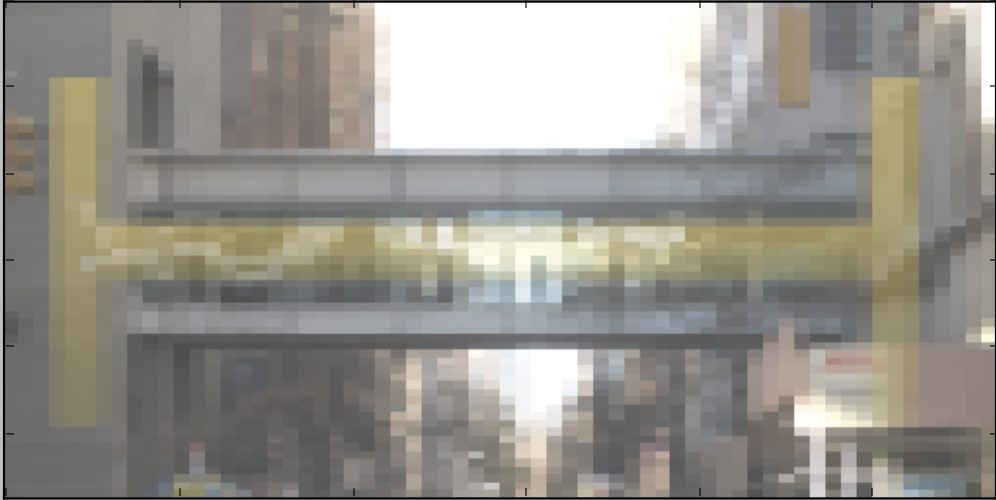
and finally:
A template program, averageImage.py, is available here. You should use this file to get started with your program.
The grading script does not run the whole program, but instead runs each of your functions separately ('unit tests') to determine correctness. As such, the names of the functions must match exactly the ones listed above (else, the scripts cannot find them).
-
Due Date: 5pm, November 3
Reading: 10-mins to Pandas, DC Pandas, Lab 6, Lab 7
Available Libraries: pandasRamen Ratings
Write a program that, given the 'Ramen Ratings' dataset, does the following:
- Ask the user for the name of the input file.
- Ask the user which column to group by (either Country or Style).
- Print the average Stars rating for each group.

A sample run:
Enter file name: ramenRatings.csv
Group by (Country or Style): Style

Average Stars rating by Style:
Style
Bar     5.000000
Bowl    3.937165
Box     4.291667
Can     3.500000
Cup     3.619075
Pack    3.863330
Tray    3.682203
Name: Stars, dtype: float64
Another sample run:
Enter file name: ramenRatings.csv
Group by (Country or Style): Country

Average Stars rating by Country:
Country
Australia        3.138636
Bangladesh       3.714286
Brazil           4.350000
Cambodia         4.200000
Canada           2.265152
China            3.634259
Colombia         3.291667
...
Name: Stars, dtype: float64
Note: You may assume that input is correct (e.g. only expected column names are entered as input).
Hint: You should use groupby() as described in Lab 6.
-
Due Date: 5pm, November 4
Reading: Think CS Chapter 6 & Lab 8
Available Libraries: turtlePolygons
Write function polygon, which takes four parameters: a turtle, number of edges, edge length, and color as a string. The functionality of polygon uses turtle object to draw a polygon with number of edges, each edge has edge length, the polygon is in color, where color can be specified in name like "red" or using a hexadecimal representation such as "#00ffff" (green + blue = cyan).
The code of function main to test polygon is as follows:
The above main function produces the following figure.def main(): tess = turtle.Turtle() polygon(tess, 5, 100, "green") polygon(tess, 6, 60, "#ff00ff") polygon(tess, 7, 70, "#ff0000") turtle.done() if __name__ == '__main__': main()
Note: The grading script does not run the whole program, but instead tests your function separately ('unit tests') to determine correctness. As such, the function name must match exactly (else, the scripts cannot find it). Before submitting your program for grading, remove any commands that are outside a function definition. To test the function you wrote, we import your file and then call the function directly. Code outside of function definitions will give compilation errors and prevents the tests from completing (giving a grade of 0). If you have extra code for testing and such, either comment it out before submitting, or use conditional execution (see Lab 7).
Hint: See Lecture 1 for the general recipe for drawing polygons.
-
Due Date: 5pm, November 5
Reading: Chapter 12 & Lab 8
Available Libraries: noneUnique Entries
When students visit the lab, their EmpID is stored as an 8-digit string. Many students visit multiple times, but we are interested in the total number of unique visitors to the lab. Write a function unique_visitors() that takes a list of 8-digit strings and returns the number of unique strings that occur.
For example:
would print:ids = ['12345678','11223344','12312323','12345678'] print("The number of unique visitors is ", unique_visitors(ids))
since there are 4 entries but the first and fourth entries are duplicates of each other.The number of unique visitors is 3Note: The grading script does not run the whole program, but instead tests your function separately ('unit tests') to determine correctness. As such, the function name must match exactly (else, the scripts cannot find it). Before submitting your program for grading, remove any commands that are outside a function definition. To test the function you wrote, we import your file and then call the function directly. Code outside of function definitions will give compilation errors and prevents the tests from completing (giving a grade of 0). If you have extra code for testing and such, either comment it out before submitting, or use conditional execution (see Lab 7).
Hint: Use a dictionary to store the IDs and return the length of the dictionary.
-
Due Date: 5pm, November 6
Reading: Chapter 12 & Lab 8
Available Libraries: noneMost Common Word
Write a function most_common() that takes a string and returns the word that occurs most often. You may assume that:
- There is exactly one word that occurs most often.
- All punctuation has been removed and words are separated by spaces (' ') and all letters are lower-case.
For example:
would print:phrase = "MORE: The more that you read, the more things you will know. The more that you learn, the more places you'll go. --Dr. Seuss" phrase = phrase.lower() punctuation_list = ['.',',','!','?',':',';','\n','\t','-',' '] for pun in punctuation_list: phrase = phrase.replace(pun,' ') print('Phrase unpunctuated:', phrase) print('Most common word:', most_common(phrase))Phrase unpunctuated: more the more that you read the more things you will know the more that you learn the more places you'll go dr seuss Most common word: moresince 'more' occurs five times in the phrase, more than any other.
Note: The grading script does not run the whole program, but instead tests your function separately ('unit tests') to determine correctness. As such, the function name must match exactly (else, the scripts cannot find it). Before submitting your program for grading, remove any commands that are outside a function definition. To test the function you wrote, we import your file and then call the function directly. Code outside of function definitions will give compilation errors and prevents the tests from completing (giving a grade of 0). If you have extra code for testing and such, either comment it out before submitting, or use conditional execution (see Lab 7).
Hint: Use a dictionary to count how many times you see each name. When you add a name to the dictionary a second time, also append the name to a list of duplicated names.
-
Due Date: 5pm, November 9
Reading: Think CS Chapter 6 & Lab 8
Available Libraries: turtleTree Drawing
Write the function
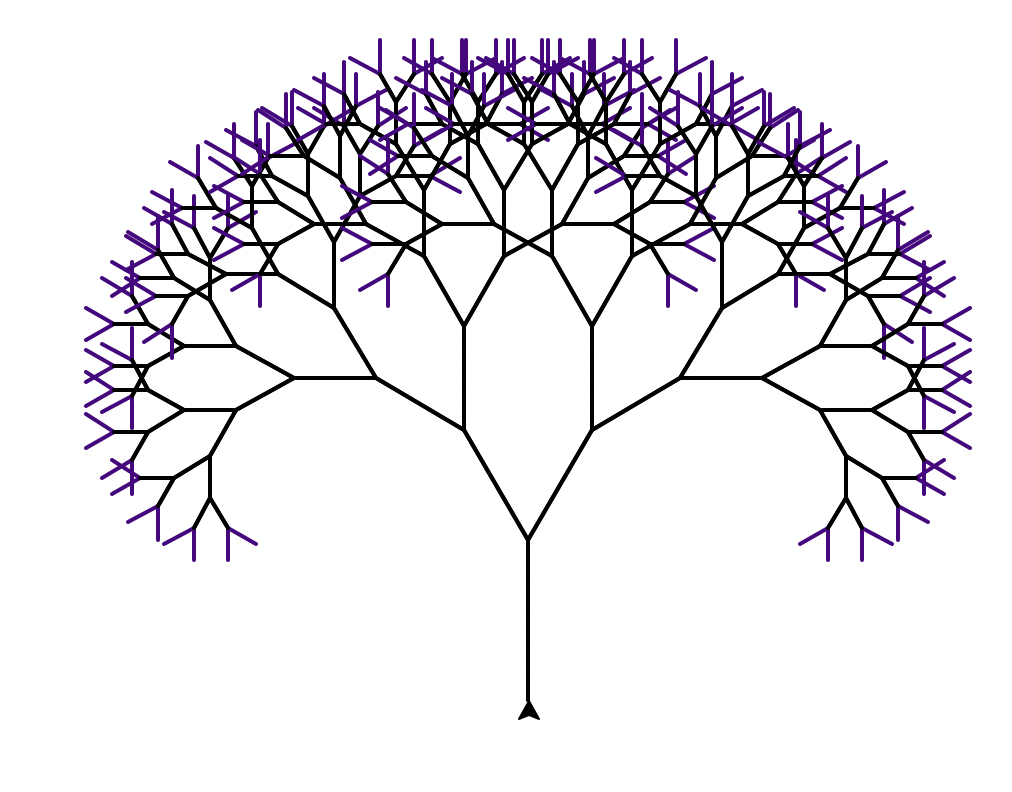
draw_tree()that implements the pseudocode below, using the turtle library:Function draw_tree() Inputs: a turtle, the branch length, the leaf color and the trunk color 1. Change the color to the trunk color. 2. If branch length <= 20 3. Change the color to leaf color. 4. Move forward the branch length. 5. Move backward the branch length. 6. Change the color to trunk color. 7. Else: 8. Move forward 80% of the branch length. 9. Turn 30 degrees to the left. 10. Call the function with 80% of the branch length, and the same turtle & colors. 11. Turn 60 degrees to the right. 12. Call the function with 80% of the branch length, and the same turtle & colors. 13. Turn 30 degrees to the left. 14. Move backward 80% of the branch length.
For example:
tess = turtle.Turtle()
tess.left(90)
tess.pensize(2)
draw_tree(tess,50,"green","brown")
will draw:

While increasing the starting branch length and changing the branch and trunk colors:
tess = turtle.Turtle()
tess.left(90)
tess.pensize(2)
draw_tree(tess,100,"indigo","black")
will draw:
The grading script does not run the whole program, but instead tests your function separately ('unit tests') to determine correctness. As such, the function name and input parameter order must match exactly (else, the scripts cannot find it).
Hint: See Section 4 of Lab 7 for details on conditional execution.
-
Due Date: 5pm, November 10
Reading: Lab 9
Available Libraries: noneFinding Errors
Lab 9 works through finding and fixing errors in a Python program. Fix all of the errors in the file errorsPassword.py and then upload the file to Gradescope.
-
Due Date: 5pm, November 11
Reading: Think CS Chapter 6 & Lab 9
Available Libraries: turtle, pandasHurricane Tracker
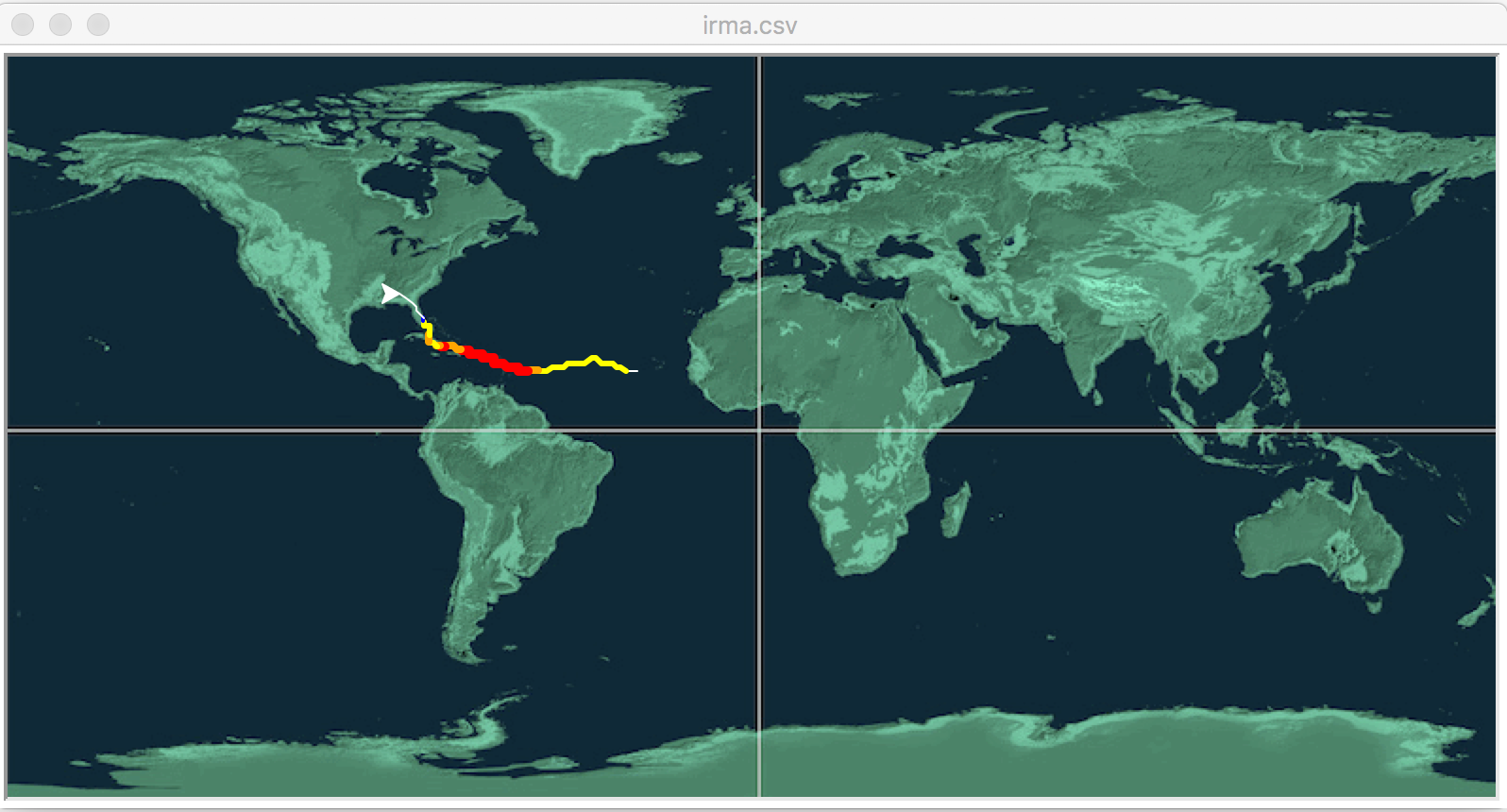
This program asks that you fill in the missing function to animate hurricane data (inspired by the 2018 Nifty Hurricane Program by Phil Ventura). Your function, animate(t,lat,lon,wind) takes as input:
- t: a turtle,
- lat: an integer storing the current latitude,
- lon: an integer storing the current longitude, and
- wind: the current wind speed in miles per hour.
Your function should move to the turtle to the current location (longitude, latitude), and then based on the Saffir-Simpson Hurricane Wind Scale, change the turtle to be:
- red and pen size 5 for Category 5 (windspeed > 157 mph)
- orange and pen size 4 for Category 4 (windspeed in 130-156 mph)
- yellow and pen size 3 for Category 3 (windspeed in 111-129 mph)
- green and pen size 2 for Category 2 (windspeed in 96-110 mph)
- blue and pen size 1 for Category 1 (windspeed in 74-95 mph)
- white and pen size 1 if not hurricane strength
Download the template program, hurricane.py. You will also need to download the background image, mapNASA.gif (link here), and put it in the same directory as hurricane.py.
The grading script does not run the whole program, but instead runs each of your functions separately ('unit tests') to determine correctness. As such, the names of the functions must match exactly the ones listed above (else, the scripts cannot find them).
Two test files (irma.csv and jose.csv) are from the Nifty site. Additional CSV files are available there.
Hint: You may find the following turtle commands useful: color(), goto(), and pensize().
-
Due Date: 5pm, November 12
Reading: 10-mins to Pandas,
DC Pandas, Plotly Maps, Lab 9
Available Libraries: pandas, plotlyNYC Hospitals Map
New York City Open Data makes data for NYC hospitals and health facilities publicly available. A sample file, nyc_hospitals.csv was downloaded and can be used to test your program.
Using Plotly Express (see Lab 9), write a program that asks the user for the name of a CSV file and the name of the output file, and creates a map with markers for all NYC health facilities from the input file. The markers should be colored by Facility Type, and when the user hovers over a marker, the Facility Name should appear in the pop-up box.
To color markers by a column in plotly express, use the color parameter, e.g.
color="Column Name".A sample run:
Enter CSV file name: nyc_hospitals.csv
Enter output file: hospitalsMap.html
which would produce the HTML file:
-
Due Date: 5pm, November 13
Reading: 10-mins to Pandas, DC Pandas, Lab 6 & 8
Available Libraries: pandasAddress DataFrame
Write a function, make_addr_df() that has 3 input parameters:
- last_names: a string containing last names, separated by spaces,
- first_names: a string containing first names, separated by spaces,
- emails: a string containing emails, separated by spaces,
hc_last = "Hunter Raab Kirschner Cantor"
hc_first = "Thomas Jennifer Anne Nancy"
hc_email = "th1870@hunter.cuny.edu jr2001@hunter.cuny.edu ak2023@hunter.cuny.edu nc2024@hunter.cuny.edu"
print(make_addr_df(hc_last, hc_first, hc_email))
will output:
	Last     First                  emails
0     Hunter    Thomas  th1870@hunter.cuny.edu
1       Raab  Jennifer  jr2001@hunter.cuny.edu
2  Kirschner      Anne  ak2023@hunter.cuny.edu
3     Cantor     Nancy  nc2024@hunter.cuny.edu
The grading script does not run the whole program, but instead runs your function separately ('unit tests') to determine correctness. As such, the name of the functions must match exactly the one listed above (else, the scripts cannot find it).
Hint: Use split() to create lists of each category entered. See Lab 8 for creating dataframes with dictionaries.
-
Due Date: 5pm, November 16
Reading: Think CS: Chapter 8 & Lab 10
Available Libraries: randomRandom Walk
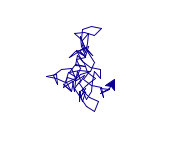
Modify the program from Lab 10 that makes a turtle walk 250 times. Each "walk" is 5 steps forward and the turtle can turn 0,45,90,135,...315,360 degrees (chosen randomly) at the beginning of each walk.
A sample run of your program:
-
Due Date: 5pm, November 18
Reading: Think CS: Chapter 8 & Lab 10
Available Libraries: noneAccount Registration
Write a program that asks the user to register an account by entering a valid username and a valid password. The program should keep prompting for each field until both are valid, displaying a specific error message for each failed condition.
A username is considered invalid if:
- it has fewer than 4 characters, or
- it matches one of the following reserved words (case-insensitive): admin, root, or guest (so Admin, ADMIN, ADMin, etc. are all invalid).
A password is considered invalid if:
- it has fewer than 6 characters, or
- it does not contain at least one digit.
Once both are valid, the program should print a confirmation message.
Note: To check whether a single character is a digit, you can use the isdigit() method. For example,
"3".isdigit()returns True, while"a".isdigit()returns False.Sample Run
Enter a username: bob
Invalid username: must be at least 4 characters.
Enter a username: ADMIN
Invalid username: reserved word.
Enter a username: falco42
Enter a password: pass
Invalid password: must be at least 6 characters.
Enter a password: password
Invalid password: must contain at least one digit.
Enter a password: pass42
Account created for falco42.
-
Due Date: 5pm, November 19
Reading: 10-mins to Pandas, DC Pandas,
Plotly Maps, Lab 9
Available Libraries: pandas, plotlyHousing Map
Using Plotly Express (see Lab 9), write a program that asks the user for the name of a CSV file, choice of unit size, and name of the output file, and creates a map with scaled markers for all the housing of that size from the input file. When the user hovers over the marker, the name of the property, the number of units of that size and the coordinates. The overall title for the map should include the housing type.
The housing data is available from NYC Open Data listing affordable and market rate housing by building location. We created a smaller file, of just 2023 housing units, Affordable_Housing_Production_by_Building_2023.csv.
If the user enters for size:
- 0: use the column: "Studio Units"
- 1: use the column: "1-BR Units"
- 2: use the column: "2-BR Units"
- 3: use the column: "3-BR Units"
- 4: use the column: "4-BR Units"
- 5: use the column: "5-BR Units"
- Otherwise use the column: "6-BR+ Units"
A sample run:
Enter input file: Affordable_Housing_Production_by_Building_2023.csv
Enter number of bedrooms (0 for studio, 1 for one bedroom,...): 2
Enter output file name: two_bed_2023.html
which would produce the HTML file:
Since the data includes all permits, the information for some private residences is not shared (marked 'Confidential' in the "Project Name" column). Since those lack information, drop those rows before plotting:
housing_df = housing_df[ housing_df['Project Name'] != 'Confidential']
Once the user has specified the housing type, you should make sure that you only plot rows that have information about that housing size (e.g. that are not null ). For example, if they are interested in 1 bedroom apartments:df = housing_df[ housing_df["1-BR Units"].notnull() ]
-
Due Date: 5pm, November 20
Reading: Lab 10, Lab 11, & Ubuntu Terminal
Available Libraries: N/ACounting Script
Using Unix shell commands, write a script that counts the number of
.pyfiles in current working directory.Submit a single text file containing your shell commands. See Lab 10.
Note: for comments, shell scripts use # in front of lines (instead of the block comments surrounded by """ """) and the first line is the "shebang" line. For a proper shell script, your file should start:
#!/bin/bash #Name: YourNameHere #Email: YourEmailHere -
Due Date: 5pm, November 23
Reading: Think CS Chapter 9 & Lab 9
Available Libraries: noneDecimal to Binary Converter
Write a function dec2bin() that takes as input a positive integer and returns a string containing the corresponding binary number. Your function should implement the pseudocode:
dec2bin( dec_num ):
1. Set bin_str = "".
2. While dec_num != 0:
3.   Let rem be the remainder of dividing dec_num by 2.
4.   Add rem to the beginning of bin_str.
5.   Let dec_num be dec_num divided by 2 (integer division).
6. Return bin_str.
For example, calling your function:
print("5 in binary is", dec2bin(5))would print:
5 in binary is 101And another example:
num = 15
print(num, "in binary is", dec2bin(num))
would print:
15 in binary is 1111Note: The grading script does not run the whole program, but instead tests your function separately ('unit tests') to determine correctness. As such, the function name must match exactly (else, the scripts cannot find it). Before submitting your program for grading, remove any commands that are outside a function definition. To test the function you wrote, we import your file and then call the function directly. Code outside of function definitions will give compilation errors and prevents the tests from completing (giving a grade of 0). If you have extra code for testing and such, either comment it out before submitting, or use conditional execution (see Lab 7).
Hint: Remember to add a number to a string, you need to cast the number to be a string first: e.g. bin_str = str(rem) + bin_str.
-
Due Date: 5pm, November 30
Reading: MIPS Wikibooks & Lab 11
Available Libraries: N/AMachine Language Hi
Write a simplified machine language program that prints: Hi World!
See Lab 11 for details on submitting the simplified machine language programs.
Hint: You may find the following table useful:
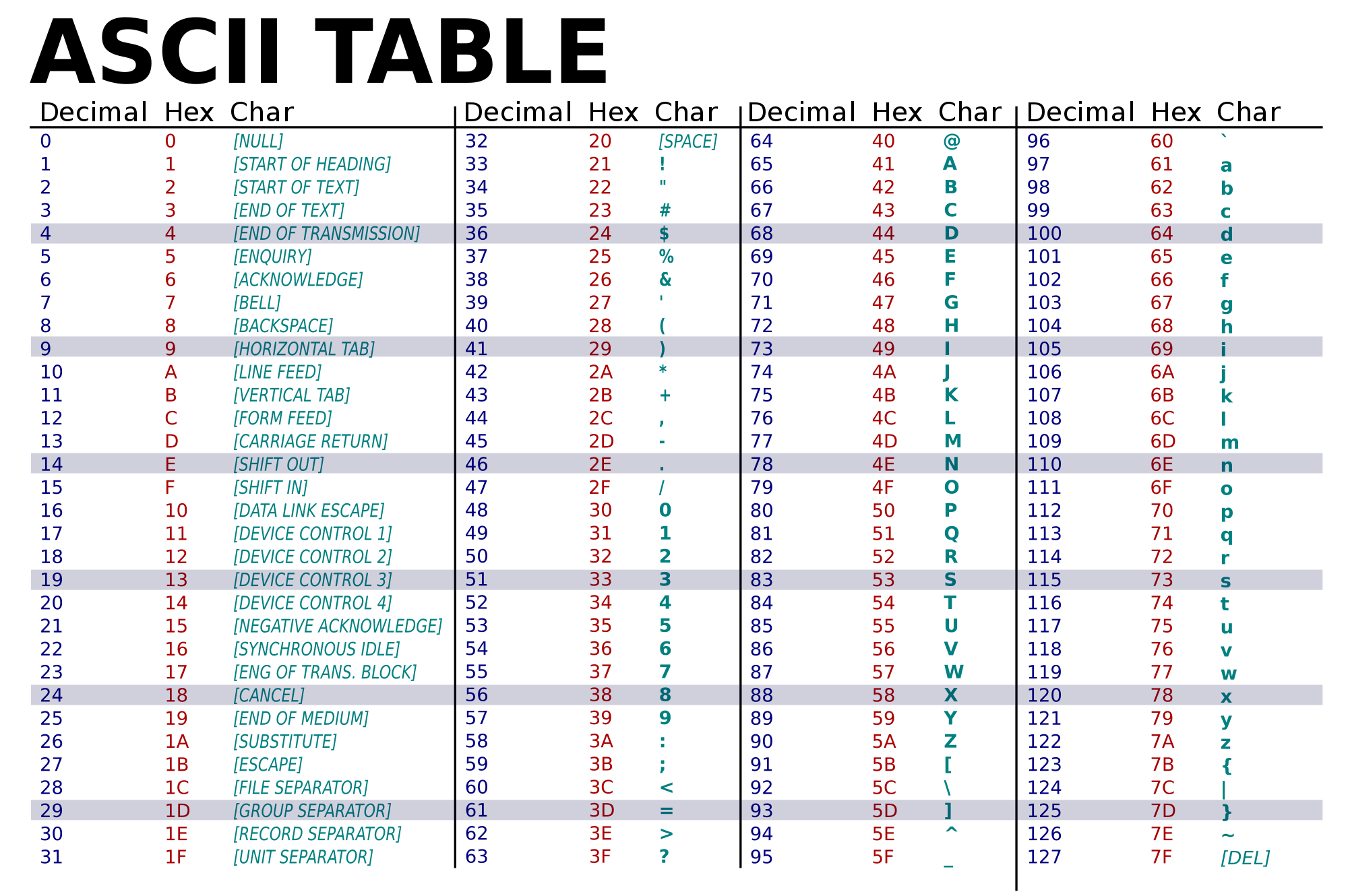
(Image from wikimedia commons)Hint: The grading scripts are matching the phrase exactly, so, you need to include the spacing and punctuation.
-
Due Date: 5pm, December 1
Reading: MIPS Wikibooks & Lab 11
Available Libraries: N/AMachine Language Loop
Write a simplified machine language program that has register $s0 loop through the numbers 10, 9, 8, ..., 2, 1, 0.
See Lab 11 for details on submitting the simplified machine language programs.
-
Due Date: 5pm, December 2
Reading: Lab 12
Available Libraries: C++C++ Hello
Write a C++ program that prints "Hello, C++!" and also prints Hello followed by your name. These greetings should be printed on two separate lines to the screen. For example, if your name is
Thomas Hunter, when your program is run, it would print:Hello, C++! Hello, Thomas HunterHint: See Lab 12 for getting started with C++.
-
Due Date: 5pm, December 3
Reading: Lab 4 & Lab 12
Available Libraries: C++Loop Practice
Write a C++ program that asks for the number of repetition, print
Practice makes perfect.that many times.A sample run of your code is as follows.
Enter repetition time: 5 Practice makes perfect. Practice makes perfect. Practice makes perfect. Practice makes perfect. Practice makes perfect. -
Due Date: 5pm, December 4
Reading: Lab 4 & Lab 12
Available Libraries: C++Temperature Converter
Write a C++ program that converts fahrenheit to celsius. Your program should prompt the user for the temperature in fahrenheit and then print out the corresponding temperature in celsius.
A useful formula: celsius = (5/9)* (fahrenheit - 32).
See Lab 4 for designing Input-Process-Output programs and Lab 12 for getting started with C++.
-
Due Date: 5pm, December 7
Reading: Lab 12
Available Libraries: C++Stripes
Write a C++ program program that asks the user for a number and draws stripes of that height and width using 'character graphics'.
A sample run:
Enter a number:  6
+-+-+-
+-+-+-
+-+-+-
+-+-+-
+-+-+-
+-+-+-
Another sample run:
Enter a number: 3 +-+ +-+ +-+ -
Due Date: 5pm, December 8
Reading: Lab 12 & Lab 13
Available Libraries: C++Credit Classification
Write a C++ program that asks the user for the current number of credit hours and prints
- "freshman" if the given hours is lower than 30.
- "sophomore" if the given hours is at least 30 and less than 61.
- "junior" if the given hours is at least 61 and less than 91.
- "senior" if the given hours is 91 degrees or greater.
A sample run:
Enter number of credit hours taken: 12
freshman
Another sample run:
Enter number of credit hours taken: 96 senior -
Due Date: 5pm, December 9
Reading: Lab 12 & Lab 13
Available Libraries: C++Validating Input (C++)
Write a C++ program that asks the user for a year, and continue asking until the number entered that is 2025 or later. Once an appropriate year has been entered, your program should then print the year entered.
A sample run:
Enter year: 2020
Year must be 2025 or later
Enter year: 1990
Year must be 2025 or later
Enter year: 2030
You entered:  2030
Hint: See Lab 10 for similar programs in Python. Rewrite in C++.
-
Due Date: 5pm, December 10
Reading: Lab 12 & Lab 13
Available Libraries: C++Population Growth
Write a complete C++ program that prints the change in population of the the United States:
where p is the population, B is the birth rate of 12.4 births for every 1000 people (12.4/1000) each year, and D is the death rate of 8.4 for every 1000 people (8.4/1000). In 2017, the population of United States was 325.7 million. Your program should ask the user for the number of years and print expected population over those years starting from 2017. Each line should have: the year and the population (in millions).p = p + Bp - DpA sample run:
Please enter the number of years: 10
Year 2017  325.70
Year 2018  327.00
Year 2019  328.31
Year 2020  329.62
Year 2021  330.94
Year 2022  332.27
Year 2023  333.60
Year 2024  334.93
Year 2025  336.27
Year 2026  337.61
Note: if you would like to make the output a bit prettier, you can include the library (
#include <iomanip>) which has a command to limit the number of places after the decimal point printed to 2 before you print:cout << setprecision(2) << fixed; -
Due Date: 5pm, December 11
Reading: Lab 12 & Lab 13
Available Libraries: C++Twos' Complement
Write a C++ program that asks the user for a whole number between -31 and 31 and prints out the number in "two's complement" notation, using the following algorithm:
- Ask the user for a number, n.
- If the number is negative, print a 1 and let x = 32 + n.
- If the number is not negative, print a 0 and let x = n.
- Let b = 16.
- While b > 0.5:
- If x >= b then print 1, otherwise print 0
- Let x be the remainder of dividing x by b.
- Let b be b/2.
- Print a new line ('\n').
A sample run:
would output:Enter a number: 8001000Another run:
would output:Enter a number: -1111111
The program turtleString.py takes a string as input and uses that string to control what the turtle draws on the screen (inspired by code.org's graph paper programming). Currently, the program processes the following commands:

Modify this program to allow the user to also specify with the following symbols:
An example with the new symbols and string rMFLFLFLFL^FFFvbmFRFRFRFRaB^FFFvqFL would create the image: